Insect Life Cycles Explained: The Key to Effective Pest Control
Understanding how insects develop from egg to adult is the secret weapon of professional pest control. Learn to identify vulnerable stages and time your treatments for maximum effectiveness.
Key Takeaways
- Only about 3% of insects are pests
- Two metamorphosis types: complete (4 stages) and incomplete (3 stages)
- Early larval and nymphal stages are most vulnerable to treatment
- Timing treatments to life stages improves effectiveness by 40-60%
- IGRs disrupt development without traditional insecticide resistance
- Understanding biology prevents wasted money on ineffective treatments
When most people encounter a pest problem, their first instinct is to grab a can of spray and hope for the best. But professional exterminators know a secret that dramatically improves their success rate: understanding the insect life cycle. By knowing exactly how pests develop and which stages are most vulnerable, you can time your treatments for maximum effectiveness while using less product.
According to Purdue University Extension, targeting insects during their larval or nymphal stages, when they are actively feeding and growing, can be significantly more efficient than attempting to control adult populations. This knowledge helps you avoid wasting money on treatments that arrive too late or target the wrong life stage.
It is also worth noting that only about 3% of insects are actually pests. Most insects are crucial to a healthy ecosystem, serving as pollinators, decomposers, and food sources for other animals. Understanding life cycles helps you target only the problematic species while preserving beneficial insects.
What is Metamorphosis?
Metamorphosis refers to the biological process through which insects undergo physical and behavioral changes throughout their life. The term comes from the Greek words "meta" (change) and "morphe" (form). Unlike mammals that simply grow larger while maintaining the same basic body plan, insects can transform dramatically between life stages.
These transformations serve important ecological purposes. By having larvae and adults occupy different niches, such as different food sources or habitats, competition between life stages is minimized. A caterpillar eating leaves does not compete with the butterfly drinking nectar.
There are two main types of metamorphosis: complete metamorphosis (holometabolism) with four distinct stages, and incomplete metamorphosis (hemimetabolism) with three stages. Understanding which type your target pest undergoes is essential for effective control.
Complete Metamorphosis: The Four-Stage Life Cycle
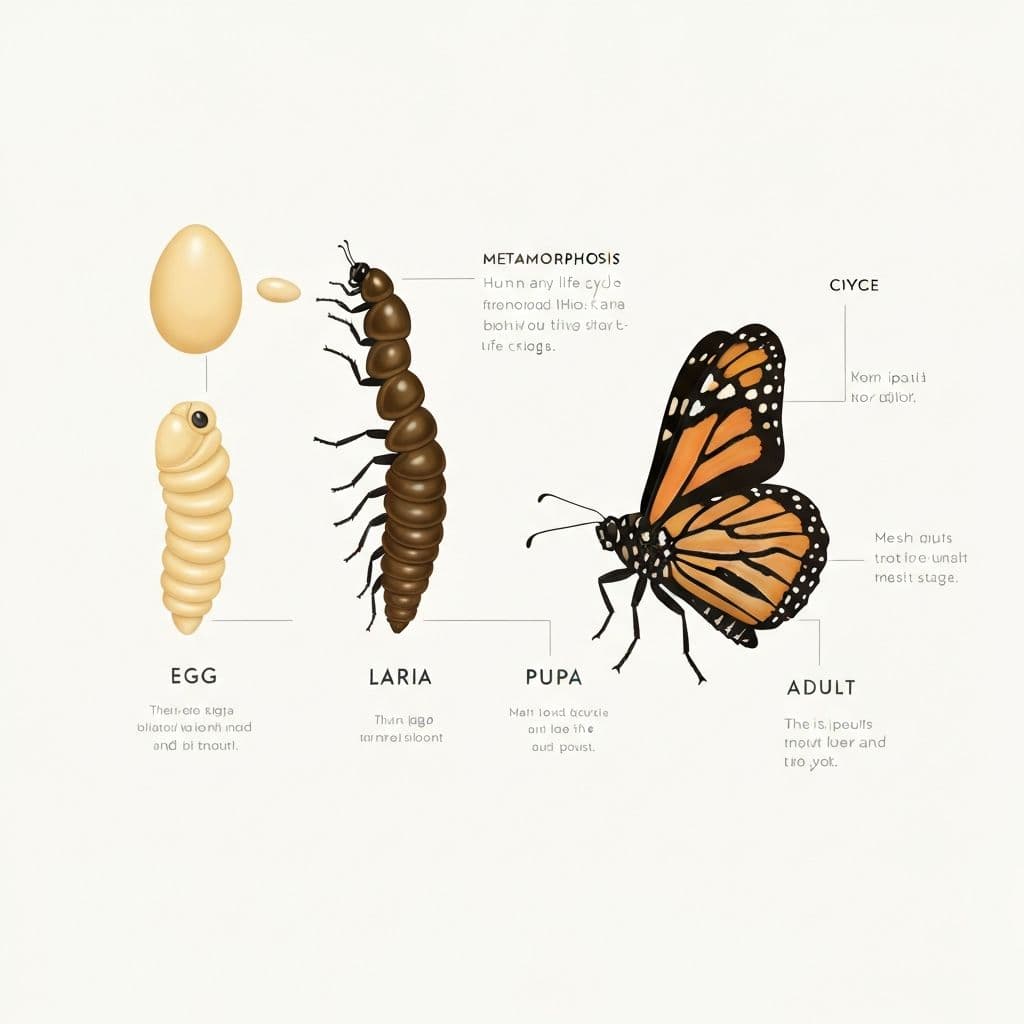
Complete metamorphosis, also called holometabolism, involves four distinct life stages: egg, larva, pupa, and adult (imago). The larva looks completely different from the adult and typically occupies a different ecological niche with different food sources.
| Stage | Description | Primary Activity |
|---|---|---|
| Egg | Laid in protected locations near food sources | Development and protection |
| Larva | Worm-like form (caterpillar, grub, maggot) | Feeding and growing |
| Pupa | Transitional stage in cocoon or chrysalis | Transformation to adult form |
| Adult | Fully formed with wings and reproductive organs | Mating and reproduction |
Insects with Complete Metamorphosis
Coleoptera
Beetles, weevils, ladybugs
Lepidoptera
Moths, butterflies, skippers
Hymenoptera
Wasps, ants, bees
Diptera
Flies, mosquitoes, gnats
Siphonaptera
Fleas
Neuroptera
Lacewings, antlions
Incomplete Metamorphosis: The Three-Stage Life Cycle
Incomplete metamorphosis, or hemimetabolism, involves only three stages: egg, nymph, and adult. There is no pupal stage. Nymphs hatch looking like miniature versions of the adult and gradually grow larger through a series of molts called instars until they reach maturity.
| Stage | Description | Primary Activity |
|---|---|---|
| Egg | Often laid in clusters in protected areas | Development |
| Nymph | Resembles adult but smaller, no wings | Feeding, growing, molting |
| Adult | Fully developed with wings (if present) | Feeding, mating, reproduction |
Insects with Incomplete Metamorphosis
Blattodea
Cockroaches, termites
Hemiptera
Bed bugs, aphids, stink bugs
Orthoptera
Grasshoppers, crickets
Mantodea
Praying mantises
Dermaptera
Earwigs
Odonata
Dragonflies, damselflies
Understanding Each Life Stage in Detail
Egg Stage
Fertilized females lay eggs in locations that offer protection and access to food for newly hatched offspring. Eggs are often the most difficult stage to control because they have protective shells and no nervous system for insecticides to affect.
Control Strategies for Eggs:
- - Physical removal and destruction of egg masses
- - Insect Growth Regulators (IGRs) that prevent hatching
- - Biological control with parasitic wasps (Trichogramma sp.)
- - Heat treatment for bed bug eggs
Larva Stage (Complete Metamorphosis)
Larvae are the immature, often worm-like forms of holometabolous insects. They are adapted for feeding and growth, with chewing mouthparts that can cause significant damage to plants, fabrics, or stored products. Larvae go through multiple growth stages called instars, molting their exoskeleton each time.
Types of Larvae:
- - Caterpillars: Moth and butterfly larvae with prolegs
- - Grubs: Beetle larvae, often C-shaped
- - Maggots: Fly larvae, legless and headless
- - Wrigglers: Mosquito larvae living in water
Nymph Stage (Incomplete Metamorphosis)
Nymphs are the immature forms of hemimetabolous insects. Unlike larvae, nymphs resemble smaller versions of adults and share similar habitats and food sources. They lack fully developed wings and reproductive organs but have the same mouthparts and feeding behavior as adults.
Nymph Characteristics:
- - Same mouthparts as adults
- - Go through 5 to 7 instars typically
- - Wing pads develop gradually
- - Often more susceptible to insecticides than adults
Pupa Stage
The pupal stage is a transitional period between larva and adult where dramatic internal reorganization occurs. Pupae do not feed or move and are often protected by cocoons, chrysalises, or underground cells. This is typically the most difficult stage to control.
Types of Pupae:
- - Chrysalis: Butterfly pupae, naked and exposed
- - Cocoon: Moth pupae wrapped in silk
- - Puparium: Fly pupae in hardened larval skin
- - Soil pupae: Many beetle species pupate underground
Adult Stage (Imago)
Adults are the fully developed reproductive stage. Most adult insects have wings (except where secondarily lost) and functioning reproductive organs. Some adults, like certain moths, do not feed at all and focus entirely on mating before dying. Others, like cockroaches and beetles, continue feeding throughout their adult lives.
Adult Behaviors:
- - Mating and egg-laying
- - Dispersal to new habitats
- - Continued feeding (species-dependent)
- - Some species form swarms or colonies
Pest Control Timing by Life Stage
Understanding which life stage is most vulnerable allows you to time treatments for maximum effectiveness. According to entomologists, targeting insects during their earliest larval or nymphal stages when they are actively feeding and growing provides the best results.
| Life Stage | Vulnerability | Best Control Methods | Challenges |
|---|---|---|---|
| Egg | Low | Physical removal, IGRs, heat | Protective shell, no nervous system |
| Early Larva/Nymph | High | Contact sprays, baits, biologicals | Short window, timing critical |
| Late Larva/Nymph | Medium | Stronger formulations, baits | Thicker exoskeleton, larger body |
| Pupa | Very Low | Physical removal, habitat modification | Protected by cocoon, does not feed |
| Adult | Medium | Contact sprays, traps, exclusion | Mobile, may not feed, hardened exoskeleton |
Important Timing Consideration
If pests are already adults and the adults do not feed (like certain moths), applying insecticides may be useless since their only purpose is to mate and lay eggs. At that point, focus shifts to preventing the next generation.
Common Household Pest Life Cycles
Here are the life cycle details for common household pests, including optimal treatment windows:
Cockroaches
IncompleteStages: Egg → Nymph → Adult
Duration: 2-3 months (German), 1-2 years (American)
Target: Early nymphs
Bed Bugs
IncompleteStages: Egg → 5 Nymphal Instars → Adult
Duration: 5-8 weeks under ideal conditions
Target: 1st and 2nd instar nymphs
Fleas
CompleteStages: Egg → Larva → Pupa → Adult
Duration: 2-3 weeks to several months
Target: Larvae in carpet fibers
Mosquitoes
CompleteStages: Egg → Larva → Pupa → Adult
Duration: 8-10 days in warm weather
Target: Aquatic larvae (wrigglers)
House Flies
CompleteStages: Egg → Larva → Pupa → Adult
Duration: 7-10 days
Target: Early larvae (maggots)
Ants
CompleteStages: Egg → Larva → Pupa → Adult
Duration: 6-8 weeks for workers
Target: Colony targeting via baits
Insect Growth Regulators (IGRs): Targeting Development
Insect Growth Regulators represent a revolutionary approach to pest control that exploits knowledge of insect life cycles. Rather than killing insects through nervous system toxicity, IGRs disrupt normal development, preventing immature stages from reaching reproductive adulthood.
| IGR Type | How It Works | Examples | Best For |
|---|---|---|---|
| Juvenile Hormone Analogs | Prevents larvae from maturing into adults | Methoprene, Pyriproxyfen | Fleas, mosquitoes, cockroaches |
| Chitin Synthesis Inhibitors | Prevents proper molting between instars | Diflubenzuron, Lufenuron | Stored product pests, termites |
| Ecdysone Agonists | Triggers premature, lethal molting | Tebufenozide, Methoxyfenozide | Caterpillars, moth larvae |
Why IGRs Are Resistance-Proof
A major advantage of IGRs is that insects cannot develop resistance to them the way they can to traditional insecticides. Since IGRs mimic the insect's own hormones, developing resistance would mean developing resistance to their own biology, which is not evolutionarily possible. This makes IGRs excellent for long-term pest management programs.
Integrated Pest Management: The Holistic Approach
Understanding insect life cycles is a cornerstone of Integrated Pest Management (IPM), a holistic approach that combines multiple control strategies to manage pest populations while minimizing environmental impact.
Cultural Controls
Modify the environment to make it less hospitable to pests
Examples: Sanitation, removing food sources, habitat modification
Mechanical Controls
Physical methods to remove or exclude pests
Examples: Traps, screens, hand-picking, vacuuming
Biological Controls
Use natural enemies to control pest populations
Examples: Parasitic wasps, predatory insects, Bt bacteria
Chemical Controls
Targeted application of pesticides as last resort
Examples: Baits, sprays, dusts, IGRs (timed to vulnerable stages)
Frequently Asked Questions
What is the difference between complete and incomplete metamorphosis?
Why is understanding insect life cycles important for pest control?
Which life stage is easiest to kill for most insects?
How long does a typical insect life cycle take?
Can insects be controlled during the egg stage?
What are Insect Growth Regulators and how do they work?
Final Thoughts: Knowledge is Power
Understanding insect life cycles transforms pest control from a frustrating guessing game into a strategic science. By knowing when pests are most vulnerable, you can achieve better results with fewer treatments and less environmental impact.
Remember that chemical controls should be the last resort in any pest management program. Start with prevention and exclusion, use cultural and mechanical controls when possible, and time any chemical applications to target the most vulnerable life stages.
For more specific guidance on managing particular pests, explore our detailed guides on cockroaches, bed bugs, fleas, and mosquitoes.