What Is a Bark Beetle?
Bark beetles are small, cylindrical insects belonging to the family Curculionidae (weevils), subfamily Scolytinae. These native forest insects bore into tree bark to lay eggs, with larvae feeding on the nutrient-rich phloem layer just beneath the bark surface. While bark beetles play a natural role in forest ecosystems by attacking weak trees, population explosions can devastate vast forest areas.
Species Overview
Several bark beetle species cause significant damage in North America:
| Species | Primary Hosts | Life Cycle |
|---|---|---|
| Mountain Pine Beetle | Ponderosa, Lodgepole, Limber Pine | 1 year |
| Spruce Beetle | Engelmann, Colorado Blue Spruce | 1-3 years |
| Ips Beetle (Engraver) | Various Pine Species | 6-8 weeks |
| Douglas-Fir Beetle | Douglas-Fir | 1 year |
| Southern Pine Beetle | Loblolly, Shortleaf, Virginia Pine | 30-60 days |
Where Bark Beetles Are Found
Bark beetles are found throughout North American forests, from the boreal forests of Canada to the pine forests of the southeastern United States. The most severe outbreaks occur in the Rocky Mountain region, Pacific Northwest, and Sierra Nevada mountains. Climate change has expanded their range northward and to higher elevations, with warmer winters allowing populations to survive in previously inhospitable areas.
In Colorado alone, spruce beetles have affected 1.84 million cumulative acres from 1996-2018, with approximately 40% of the state's spruce-fir forest ecosystems impacted. Mountain pine beetles have killed trees across millions of acres from British Columbia through Colorado.
How to Identify Bark Beetles
Size, Color, and Appearance
Adult bark beetles are small, cylindrical insects typically measuring 3-7mm (1/8 to 1/4 inch) in length. Most species are dark brown to black, though some appear reddish-brown. Key identifying features include:
- Body shape: Cylindrical, bullet-shaped with a rounded rear end
- Antennae: Elbowed with a club-shaped tip
- Head: Partially hidden beneath the thorax when viewed from above
- Elytra (wing covers): Often with rows of small pits or ridges
Signs of Bark Beetle Infestation
Early detection is critical for protecting trees. Watch for these warning signs:
Pitch Tubes
Small, popcorn-shaped masses of resin on the trunk surface. These form when the tree attempts to "pitch out" boring beetles. Reddish-brown pitch tubes indicate a failed defense.
Boring Dust (Frass)
Fine, reddish-brown sawdust accumulating in bark crevices, around the tree base, and on spider webs nearby. This indicates active beetle tunneling beneath the bark.
Fading Needles
Healthy green needles that turn yellowish, then rusty red. By the time an entire crown is red, beetles have typically already exited and moved to new hosts.
Woodpecker Activity
Heavy woodpecker feeding strips bark as birds search for beetle larvae. Large patches of light-colored, exposed wood indicate severe infestation.
Gallery Patterns
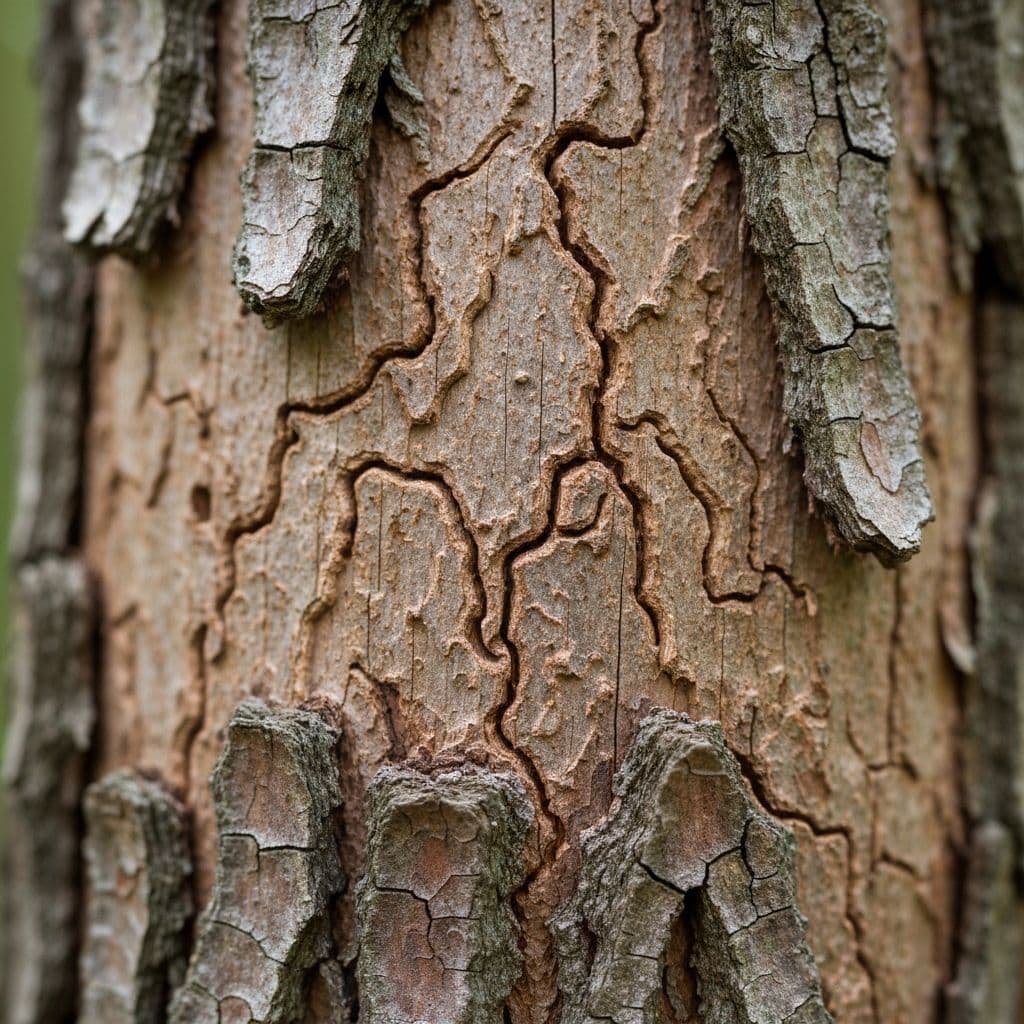
Peel back loose bark to reveal tunneling patterns. Mountain pine beetles create distinctive J- or Y-shaped egg galleries carved into the inner bark.
Blue Stain Fungus
Beetles carry blue stain fungus that blocks water-conducting tissues. Cross-cut sections show distinctive blue-gray streaking through the sapwood.
What Damage Do Bark Beetles Cause?
Damage to Trees
Bark beetles kill trees through a combination of physical damage and biological warfare. As adults bore into the bark, they introduce blue stain fungi (Ophiostoma species) that colonize the sapwood and block the tree's water-conducting tissues. Meanwhile, larvae feed on the phloem layer, disrupting nutrient transport. This two-pronged attack typically kills trees within weeks to months.
Governor's Warning (December 2025)
"Most or nearly all mature Ponderosa pines will be killed by pine beetles in the western front range over the next several years." — Governor Jared Polis, Colorado
Signs of Infested Wood
Infested wood displays several characteristic signs:
- Entry and exit holes (1-3mm diameter) scattered across bark surface
- Winding gallery patterns visible when bark is removed
- Blue-gray staining in sapwood visible in cross-sections
- Loose, easily peeling bark on dead or dying trees
- White larvae or pupae in galleries (seasonal)
How Fast They Spread
Bark beetle spread varies dramatically based on population levels and environmental conditions. During endemic (low population) periods, beetles primarily attack weakened or stressed trees. However, during epidemic outbreaks, populations can explode exponentially:
| Outbreak Phase | Spread Rate | Tree Selection |
|---|---|---|
| Endemic | Localized, scattered | Stressed, injured, or windthrown trees |
| Incipient | Expanding patches | Large diameter trees, older stands |
| Epidemic | Thousands of acres/year | Any suitable host, regardless of health |
Why Bark Beetles Attack Trees
Weak or Stressed Trees
Bark beetles preferentially attack trees that are already compromised. Stressed trees produce fewer defensive compounds (terpenes and resin) and cannot effectively "pitch out" invading beetles. Trees become stressed from:
- Drought: Reduces resin production and overall tree vigor
- Root damage: Construction, compaction, or disease
- Competition: Overcrowded stands compete for water and nutrients
- Other pests: Defoliators, diseases, or previous beetle attacks
- Age: Older, mature trees are more susceptible than young, vigorous trees
Environmental Factors
Climate change has dramatically increased bark beetle populations and expanded their range. Key environmental factors include:
Warmer Winters
Beetle larvae require sustained temperatures below -30°F to experience significant mortality. Warmer winters allow more beetles to survive, accelerating population growth.
Extended Drought
Multi-year droughts weaken tree defenses across entire forests, making them vulnerable to mass attacks that would fail against healthy trees.
Longer Growing Seasons
Warmer temperatures allow beetles to complete their life cycles faster. Species that typically take two years can shift to one-year cycles, doubling reproductive rates.
Windthrow Events
Storms that knock down trees create ideal beetle breeding habitat. Downed trees allow populations to build before attacking standing trees.
How to Get Rid of Bark Beetles
Removing Infested Wood
The most effective control for active infestations is removing and destroying infested wood before beetles emerge to attack new trees. Timing is critical—beetles must be destroyed while still inside the wood:
- Fall/Winter removal: Fell infested trees after beetle flight season ends and before spring emergence
- Solar treatment: Cut logs, stack in full sun, and cover with clear plastic to heat-kill beetles
- Debarking: Remove bark from cut logs to destroy larvae and pupae
- Chipping: Process infested wood into chips, which dry too quickly for beetle survival
- Burning: Where permitted, burning infested slash destroys all life stages
Chemical Treatments
Chemical treatments are preventive only—they cannot save trees already infested. Insecticides create a barrier that kills beetles before they can bore into the bark. Treatment must be applied before beetle flight season begins:
Timing for Preventive Sprays
- Mountain Pine Beetle: Apply by late June before July flight
- Spruce Beetle: Apply by late May before late May-July flight
- Ips Beetles: Apply in early spring; multiple generations require repeat applications
Natural Control Methods
Several natural and low-chemical approaches can help manage bark beetle populations:
- Trap trees: Fell trees to attract beetles, then destroy before emergence
- Pheromone packets (MCH): Methylcyclohexanone disrupts beetle aggregation on treated trees
- Verbenone: Anti-aggregation pheromone signals "tree is full" to incoming beetles
- Forest thinning: Reduces competition and increases tree vigor to resist attacks
Best Treatments for Bark Beetles
Insecticide Sprays
Pyrethroid insecticides are the primary preventive treatments for bark beetles. The Colorado State Forest Service recommends spraying only high-value trees near homes, businesses, or recreation sites:
| Active Ingredient | Products | Duration |
|---|---|---|
| Carbaryl | Sevin SL | 1 season |
| Permethrin | Astro, Permethrin Pro | 1 season |
| Bifenthrin | Onyx Pro, Bifen I/T | 1-2 seasons |
Preventive Tree Treatments
Beyond insecticides, several preventive treatments can protect trees:
- MCH packets: Hang Methylcyclohexanone packets on spruce trees to deter spruce beetles
- Verbenone pouches: Anti-aggregation pheromone pouches for mountain pine beetle
- Systemic injections: Emamectin benzoate injections provide 2-3 year protection
Professional Pest Control
For large trees or severe infestations, professional arborists and pest control operators offer specialized services:
- High-pressure bark sprays reaching the full trunk height
- Tree injections for systemic protection
- Safe removal of large infested trees
- Forest-wide management planning for large properties
How to Prevent Bark Beetle Infestation
Tree Care and Maintenance
The most effective long-term defense against bark beetles is maintaining healthy, vigorous trees that can defend themselves:
Deep Watering
Water trees deeply once a month during dry periods, even in winter. Stressed, drought-weakened trees are most vulnerable to attack.
Forest Thinning
Reduce stand density to minimize competition for water and nutrients. Thinning promotes tree vigor and reduces fire risk.
Slash Removal
Remove or destroy pruning debris and windthrown trees promptly. Downed wood provides breeding habitat for beetle populations.
Age Diversity
Manage for diverse age classes and tree species. Beetles prefer large, mature trees and cannot sustain outbreaks in diverse stands.
Monitoring and Early Detection
Regular monitoring allows early intervention before infestations spread:
- Inspect trees monthly from May through October for pitch tubes and boring dust
- Watch for fading or discoloring needles in the crown
- Note increased woodpecker activity on trunks
- Check state forest service maps for outbreak areas near your property
- Contact a certified arborist if you suspect infestation
Are Bark Beetles Dangerous to Homes?
Bark beetles do not infest structural wood in homes. They require living or freshly cut wood with moisture and phloem (the nutrient-conducting layer beneath bark) to survive. Dried, processed lumber in homes is not suitable habitat.
However, bark beetles pose indirect risks to homes:
- Falling hazards: Dead trees near structures can fall, especially during storms or snow loading
- Fire risk: Masses of dead trees dramatically increase wildfire fuel loads
- Property values: Large-scale tree mortality can reduce property values
- Firewood storage: Storing infested firewood can spread beetles to nearby healthy trees
Firewood Safety
Never store freshly cut pine or spruce firewood near living trees during beetle flight season. Process or solar-treat infested wood promptly, and avoid transporting firewood between areas to prevent spreading infestations.
FAQs About Bark Beetles
How do I know if my tree has bark beetles?
Can a tree survive a bark beetle infestation?
When is the best time to treat trees for bark beetles?
Do bark beetles attack all types of trees?
How fast do bark beetles spread through a forest?
Are bark beetles dangerous to my home or firewood?
Final Tips to Protect Trees from Bark Beetles
Protecting your trees from bark beetles requires a proactive, integrated approach. Here are the key takeaways:
- 1Water deeply during dry periods to maintain tree vigor and resin production
- 2Inspect monthly from May through October for early signs of infestation
- 3Apply preventive sprays in spring to high-value trees before beetle flight
- 4Remove infested trees and slash promptly to reduce beetle breeding habitat
- 5Thin overcrowded stands to reduce competition and promote tree health
- 6Consult a certified arborist for assessment and professional treatment options